

Devstars
Blog
Date: 15/05/2026
Stuart WatkinsWhen you live on an island, you have to love the sea. My family and I are at the beach several times a week. Sea swimming, paddleboarding, kayaking, a bit of surfing, and I’m just starting to learn to sail. It’s brilliant, and it’s also genuinely dangerous if you stop paying attention.
A few conversations got me building this. Friends who’ve known these waters their whole lives. My sailing coach Jono. The same question kept coming up. Where are the best places to do certain things, and what do you need to watch for once you’re there?
Because conditions in Jersey change fast. You can be on a beach that feels completely calm because the cliffs are sheltering you from the wind. Paddle out 200 metres and suddenly the wind is on you and you’re being pushed somewhere you didn’t want to go. Currents shift within an hour or two. One moment they nudge you gently down the beach, which is fine. The next they pull you out to sea, which is not.
So I sat down for a couple of days and had a play. The Admiralty publishes really good data on how currents move around the island and the Channel in general. Combine that with weather, tides, and the topography of the island, and you start to get something useful.
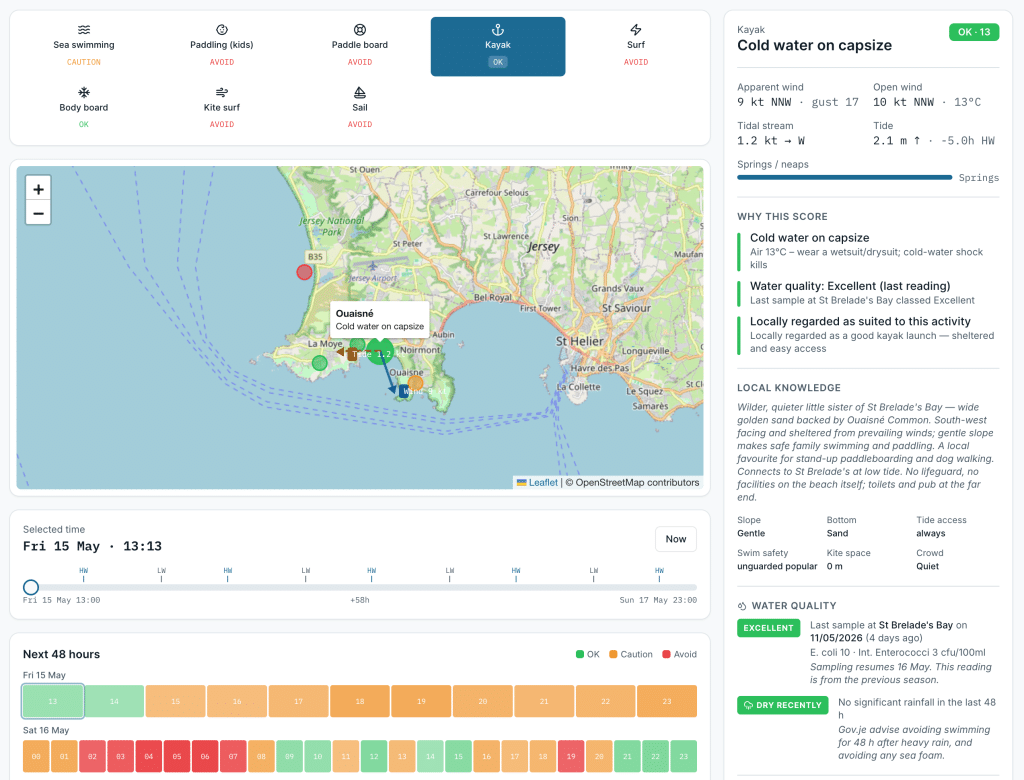
The result is live at beach.devstars.je. It’s beta. It’s not finished. But it’s the kind of project that wouldn’t have existed a year ago, because I would never have got round to it.
It’s an hourly beach hazard forecast for Jersey, Channel Islands. You pick a beach and an activity. It tells you whether conditions are sensible right now, and how they change through the day.
The activities it covers: swimming, paddling, paddleboarding, kayaking, surfing, bodyboarding, kitesurfing, sailing.
The factors it blends: tides, currents, wind, cliff shadow, thermal effects, and sea-water quality.
It’s in beta. Some bits are pretty damn good. Some bits need work. That’s honest, and it’s also the point. It’s an early-stage model-based forecast for guidance only. Always check RNLI flags, lifeguard advice and the States of Jersey sea safety guidance before entering the water.
I’m a marketer who can read code, not a developer who ships production apps. A traditional brief, design, build, test cycle would have killed this project before it started, because it’s a side project with no budget and no client.
Comet is Perplexity’s agentic browser. It runs as your browser, sees what you see, and you can talk to it about whatever is on the screen. For a project like this, that turned out to be the right tool, because so much of the work was not the coding itself. It was the surrounding research. What does the tide API actually return at low water. What does the Met Office say about Jersey wind patterns this week. What does a sensible kitesurfing wind range look like. How do other beach apps present this. All of that lives in the browser, and Comet lives there with you.
The build itself was conversational. Describe what I wanted, look at what came back, push back where it was wrong, move on when it was right.
Four things, in order of how often I had to relearn them.
When I was vague, I got vague output. When I described the exact behaviour I wanted, with an example of a beach and a condition and what the tool should say, the result was sharp. The skill isn’t knowing how to code. It’s knowing how to describe what good looks like.
The skeleton of the app came together fast. The bit that took the time was the edge cases. What happens at the turn of the tide. What happens when one of the data sources fails. What happens on a Safari version from 2021. That’s the part nobody wants to do, and AI doesn’t volunteer to do it either.
The AI will happily build you a feature nobody asked for. It will suggest a chart when a sentence is clearer. It will pad the interface with options that confuse the user. Knowing what to leave out is a senior skill, and it doesn’t transfer to the tool.
Getting something live, on a real domain, with analytics and OG cards and a meta description that makes sense, that’s a lot of small jobs the AI doesn’t surface unless you ask. The gap between “works on my machine” and “live at a URL someone can visit” is still mostly human.
This is the bit worth paying attention to.
The agency conversation is shifting. A year ago, an idea like Beach Aware needed a developer, a designer, a project manager and four weeks. Now it needs a clear head, a weekend, and a willingness to push back on what the AI offers.
That doesn’t put agencies out of business. It changes what agencies are for.
Our job at Devstars is increasingly the bits AI doesn’t do. The strategic framing of what you’re actually building and why. The production-grade engineering when something needs to scale. The integration with the rest of your business systems. The long-term care of the thing once it’s live. The judgement about what to leave out.
A prototype is not a product. A weekend build is not a business. But the gap between idea and prototype has collapsed, and that changes who can sit at the table with an agency. Smart clients are about to walk in with working things, and the conversation will start further down the line than it used to.
Beach Aware is at beach.devstars.je. It’s beta. It will have bugs. If you’re on the island, give it a go on a weekend trip to the beach and tell me what it got right and what it got wrong. Stuart@devstars.je.
If you’re thinking about building something small for your own business and you’re not sure where to start, that’s a conversation I’m always up for too.
Always check RNLI safety advice and States of Jersey sea safety guidance before entering the water. Beach Aware is for guidance only.
Stuart Watkins is the founder of Devstars, a digital growth agency working from Jersey and London. He spends most of his time helping ambitious businesses build production-grade digital infrastructure, and the rest of it on the beach.
Tell me what you’re trying to fix. Half an hour, no pitch, no slide deck.
If we’re the right fit we’ll talk about what’s next. If we’re not, I’ll point you to someone who is.


